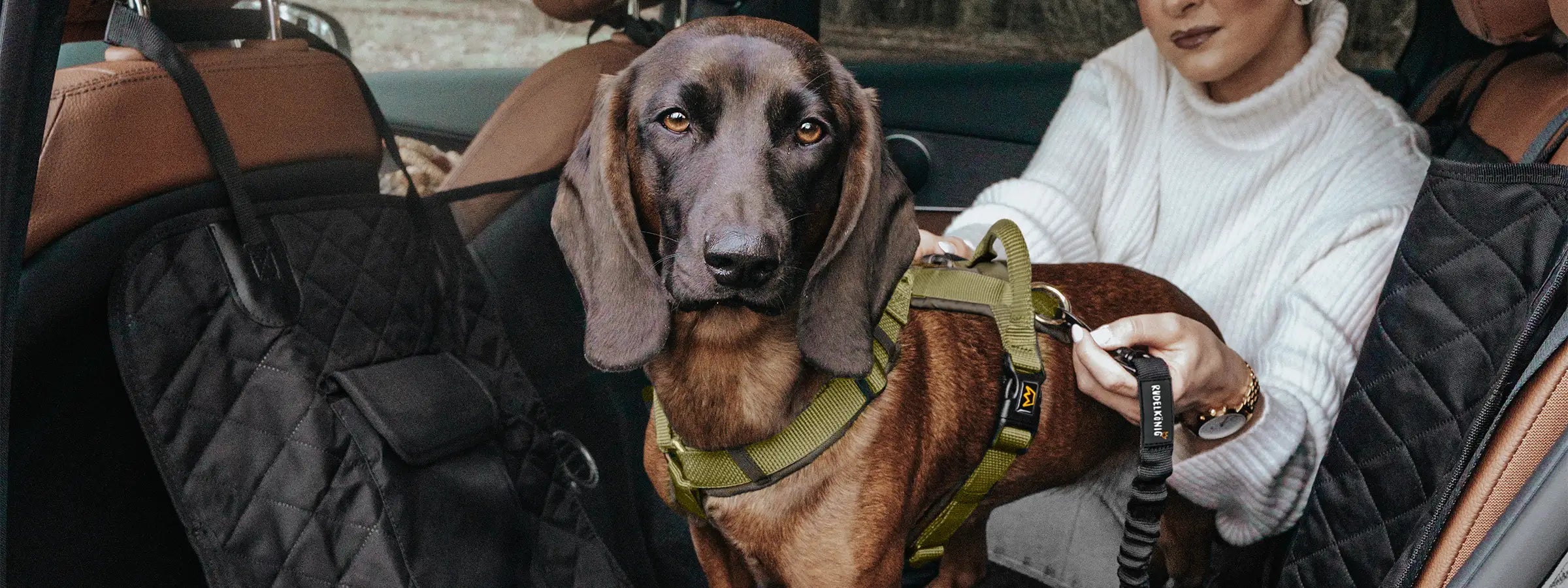
The best dog harness for your four-legged friend from Rudelkönig
A dog harness offers your dog more comfort and safety than a collar by distributing pressure evenly and preventing injuries. Are you looking for the best dog harness for your four-legged friend? In this article, we present different types of dog harnesses and explain what you should look for when choosing one.
The most important facts at a glance
- A dog harness improves the dog's well-being and safety by distributing pressure evenly and preventing injuries to the neck area.
- There are different types of dog harnesses (e.g., H-harness, Y-harness, Norwegian harness), each offering specific advantages for different dog breeds and sizes.
- Important selection criteria for a dog harness are the fit, the material, the workmanship, as well as the padding and comfort, in order to avoid restrictions of movement and skin irritation.
Why a dog harness?
A dog harness promotes the animal's well-being, allows for better control, and provides support in emergency situations. Unlike a collar, a harness distributes pressure evenly across the dog's body, significantly reducing the risk of injury. A harness is the safer choice over a collar, especially for active dogs and those with neck problems.
When pulling on the leash, a dog harness distributes the pressure evenly across the body, preventing injuries to the trachea and cervical spine. A collar, on the other hand, can cause serious health problems when pulled hard, such as injuries to the trachea and cervical spine. This is especially important for puppies, whose neck region is still very sensitive.
A dog harness is one of the most important purchases for a good relationship between humans and dogs. Not only does it offer safety and comfort, but it also allows for stress-free and pleasant control of the dog. No-pull dog harnesses are particularly beneficial for puppies, as they distribute the pulling force evenly and are therefore ideal for dogs that pull on the leash.
The different types of dog harnesses
There are a variety of dog harnesses available, each offering different advantages. Among the best-known types are:
- the H-harness
- the Y-harness
- the Norwegian harness
- the Step-In harness
- chest harness
Each of these variants has its own special features and is suitable for different dog breeds and sizes.
The H offers a high degree of adaptability in terms of size and can grow with your dog as it grows. The Y harness is characterized by its Y-shaped design in the chest area and offers a snug fit.
The Norwegian harness is easy to use and particularly suitable for dogs with deep chests. The step-in harness is ideal for anxious dogs as it is easy to put on.
H-harness
The H is a special dog harness that has an H shape and runs around the dog's chest and belly area. This design ensures even pressure distribution across the dog's body and prevents injuries to the neck area. Particularly active dogs that need a lot of exercise benefit from an H, as it allows them to move freely while remaining safe and comfortable.
The H-harness is also ideal for dogs with neck problems, as it takes the pressure off the sensitive neck area and distributes it across the chest and abdomen. It also offers a high degree of adjustability in terms of size, which is particularly advantageous if the dog is still growing.
Y-harness
The Y-harness has a Y-shaped design in the chest area, which does not require any straps to be connected by hand and offers a snug fit. This snug fit minimizes the risk of the dog slipping out of the harness during training.
Another advantage of the Y is that it has no elements restricting movement in the shoulder area, which significantly increases the dog's freedom of movement. This makes it an ideal choice for dogs that run and play a lot without restricting their movements.
Norwegian harness
The Norwegian harness is particularly easy to use, as it is pulled over the dog's head and secured with a chest strap. This ease of use makes it particularly popular with dog owners who prefer a harness that is easy to put on.
This harness is particularly suitable for dogs with deep chests, as the chest strap runs horizontally along the chest, providing an optimal fit. Compared to other harnesses, such as the saddle harness, the Norwegian harness is characterized by its simple and effective design.
chest harness
A chest harness for dogs ensures even pressure distribution and protects the neck and shoulder area during wild adventures. It often offers greater comfort than a classic collar and is particularly suitable for dogs that pull on the leash or are sensitive to pressure on their neck. Modern chest harnesses are available in various sizes, materials, and designs so that every four-legged friend can find the perfect fit. Regular readjustment and a proper fit guarantee safety and freedom of movement on every walk. Chest harnesses are usually available in sizes S, M, L, and XL.
Step-in harness
The Step-In is put on by placing two loops over the dog's front legs, making it ideal for anxious dogs. This method of putting it on reduces stress for dogs that dislike having something pulled over their heads.
Step-ins are particularly suitable for small dogs, as they are easy to put on and offer a good fit. They are available in various sizes and colors, so you can find the right harness for every dog breed and every taste.
Selection criteria for the best dog harness
When choosing the best dog harness, there are several important criteria to consider. These include fit and size, material and workmanship, as well as padding and comfort. A well-fitting dog harness should be individually adjustable to ensure an optimal fit during your adventures.
A poor fit can restrict the dog's movement or even be dangerous. It is therefore important to pay attention to quality, type of fastening, and comfort. Functionality, fit, material, and padding are the most important features to consider when choosing a dog harness.
Fit and size
The right size is crucial for maximizing the functionality of the harness. To determine the optimal size for a dog harness, the following factors should be taken into account:
- Size charts (xs, s, m, l, xl)
- bust size
- back length
- shoulder height
- waist size
- dog size
- Weight of the dog
When purchasing, make sure that the harness is not too tight or close to the armpit area to avoid skin chafing. A well-fitting harness should not slip back and forth or be too tight.
The straps of the harness should not be too narrow to avoid cutting into the fur and skin.
Material and workmanship
Dog harnesses should be made of sturdy materials to withstand the daily wear and tear of your pet.
When processing, you should pay attention to the following points:
- double-stitched seam
- sturdy closures
- sturdy materials
- meticulous workmanship
These aspects are crucial for the durability and comfort of dog harnesses.
Upholstery and comfort
Padding is important to prevent pressure points and increase the dog's comfort. An ergonomic harness promotes freedom of movement and reduces the risk of injury.
Puppy harnesses: Special requirements for young dogs
Puppy harnesses are part of the basic equipment for puppies and are important for preventing health problems caused by pulling on the leash. These harnesses protect the dog's sensitive neck and spine during leash training, which is especially important for puppies that tend to run off suddenly when distracted.
For puppies, the harness should be adjustable and grow with them to ensure an optimal fit. The straps of the puppy harness should be well padded at the contact points to prevent pressure points.
Common mistakes when buying a dog harness
When buying a dog harness, mistakes are often made that can cause long-term health problems for the dog. Here are some common mistakes that should be avoided:
- Choosing a harness that does not fit the size and breed of the dog.
- Use of a harness that restricts the dog's freedom of movement.
- Neglecting materials that can cause skin irritation.
- Lack of adjustment options to ensure an optimal fit.
- Ignoring the recommendations of veterinarians or specialists.
These errors can lead to muscle and joint problems.
Saddle and Norwegian harnesses should be avoided as they significantly restrict the dog's shoulder movements. A well-fitting harness should be adjusted so that a hand can fit underneath it to ensure that it is not too tight.
Tips for getting used to the dog harness
The process of getting used to a harness should be done gradually to minimize stress. It is important to slowly increase the amount of time the harness is worn to avoid overwhelming the dog.
The dog's trust should be established before starting to put on the harness. Positive feedback such as treats can help make putting on the harness a pleasant experience. Distraction techniques, such as offering a toy while putting on the harness, can reduce stress.
Care and maintenance of dog harnesses
Caring for your dog's harness is important to ensure its durability and functionality. The care of dog harnesses varies depending on the material; sturdy nylon models can often be machine washed, while more delicate harnesses require hand washing.
Before washing, the dishes should be checked for damage and coarse dirt should be removed. For machine washing, the dishes should be placed in a laundry bag and a mild detergent should be used. After washing, the dishes should be dried in a well-ventilated place without direct sunlight to prevent damage to the material.
Summary
Choosing the right dog harness is crucial for your dog's well-being and safety. A well-fitting harness made of sturdy materials and well-crafted can minimize the risk of injury and maximize your dog's comfort.
The top recommendations for 2025, available in a wide range of colors, offer an excellent combination of quality, comfort, and functionality. Whether for puppies, small dogs, or adult dogs, for everyday use or special activities—the right harness makes all the difference. Enjoy safe and comfortable walks with your four-legged friend and make the most of your time together.
Frequently asked questions
Why is a dog harness better than a collar?
A dog harness is better than a collar because it distributes pressure evenly across the dog's body, preventing injuries to the neck area. This ensures greater safety and comfort during walks.
Which dog harness is best suited for puppies?
Adjustable and well-padded harnesses, such as the Hunter Hilo Comfort and the Tripoli puppy harness, are best suited for puppies. These ensure comfort and adaptability as the dog grows.
How do I find the right size for the dog harness?
To find the right size for your dog's harness, you should use the size charts and accurately measure your dog's dimensions (chest circumference, back length, shoulder height, waist circumference, and weight). This will ensure an optimal fit.
What are the most common mistakes when buying a dog harness?
The most common mistakes when buying a dog harness are choosing harnesses that restrict the dog's freedom of movement and putting on harnesses that are too tight. These aspects must be taken into account to ensure the dog's well-being.
What is the best way to get my dog used to a harness?
Gradually accustom your dog to the harness by building trust and using positive reinforcement such as treats. This promotes a positive association and makes it easier for your dog to get used to it.
Walking your dog with Rudelkönig means quality and comfort for you and your four-legged friend! Our leashes, whether multifunctional, drag or training leashes, give you the freedom you need while providing your dog with the safety it deserves. Our sturdy collars and harnesses are not only functional and comfortable, but also stylish – perfect for every dog-owner team! Snap them up now!