




More freedom, more security – your path to better relationships
A walk through the forest, your four-legged friend sniffs curiously at the side of the path, lifts his nose into the wind - but instead of storming off uncontrollably, he stays within the radius. You are connected, not only by the towline, but also by trust. That is exactly the goal of successful towline training.
Especially in a world where leash requirements, hunting behavior and changeable environments are part of everyday life, drag leash training offers a real alternative: more freedom for the dog, which gets a little more freedom of movement without you losing control, more control for you - and a stable relationship as a result. Training brings many advantages, especially in different situations.
What is towline training anyway? A short definition
When training on a leash, you use a particularly long leash - usually between 5 and 15 meters - to give your dog more freedom of movement without letting him off the leash completely. In this way, your pet can learn to act at a greater distance from you, to follow commands and to orientate themselves towards you. The training is particularly helpful for recall, anti-hunting training or getting young dogs used to the leash. In this section you will learn everything you need to know about the basics of towline training.
Leash training is one of the most effective forms of dog training - especially for dog owners who value freedom, control and a stable recall. It's not just about obedience, but about consciously working on your bond. The following content provides you with more tips and details on successful towline training, including useful training tips.
Why towline training at all?
Many dog owners want to give their pet more freedom without losing control - the towing leash gives the dog the exercise it needs, even when it is on a leash. A good towing line - perhaps made of biothane or robust fabric - creates this space safely and in a controlled manner. Whether in the forest, on meadows or near roads: your dog has a larger range of motion, but remains connected to you through the leash.
Especially with young dogs or puppies, the drag leash is a valuable aid to reinforce basic commands, train recall or prevent unwanted behavior such as rushing. Training with a towline is also a proven intermediate step for the transition from being on a leash to controlled free running.
Another advantage: You give your dog more freedom - and you still remain able to act if unexpected situations arise. This is particularly helpful for dogs whose hunting instincts are strong or for whom leash control still needs to be practiced. Leash training is also an important part of training your dog as it helps to promote desired behavior and strengthen the bond between dog and owner.

The right equipment: Which towing line is right for you?
Choosing the right towline is crucial to ensuring safety and effectiveness during training. When buying a towline, you should pay attention to quality, material and appropriate length.
There are different types of linen such as biothane or fabric, each of which offers its own advantages: Biothane linen is particularly weatherproof and easy to care for, while fabric linen is light and flexible. The right choice of leash depends on your dog's needs and the area of use.
Ideally, attach the leash to a well-fitting chest harness to avoid injuries to your dog's neck and to protect his anatomy.
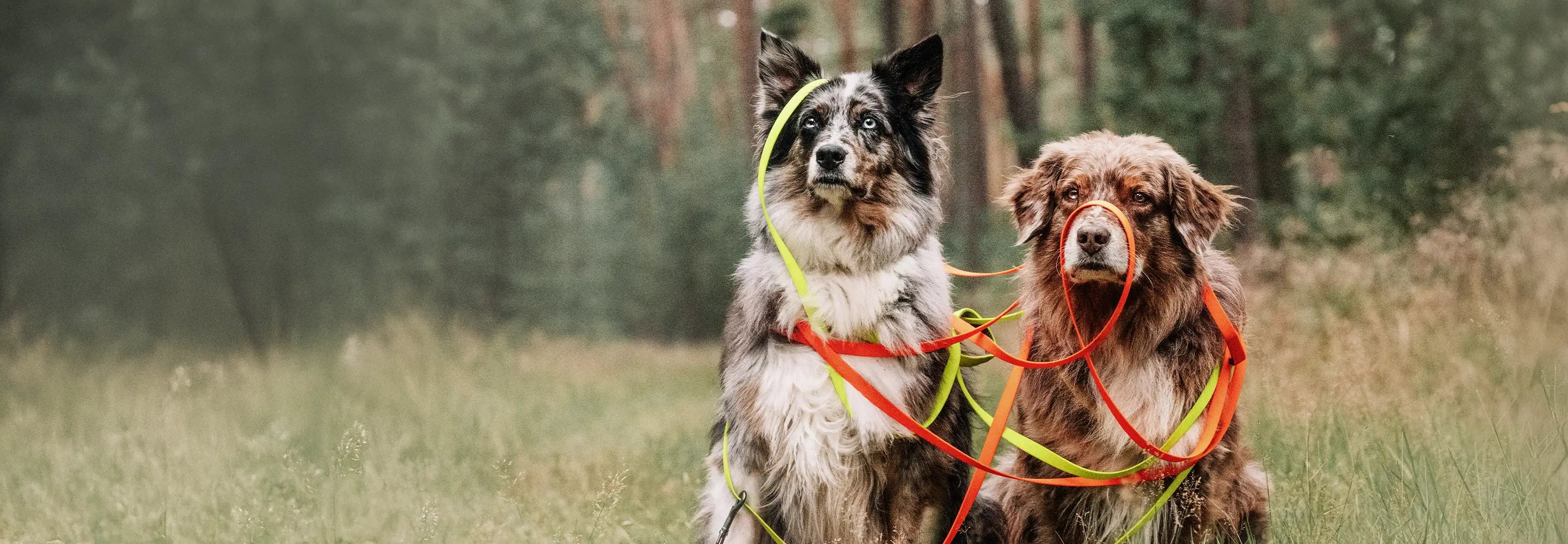
At Rudelkönig you will find high-quality models like this Biothane towing line 10m, variants with Hand strap or even Fabric linen in neon yellow or black. Towing lines should be as free of unnecessary loops as possible so that they do not get caught in the undergrowth and safety during training is guaranteed. Choose the length (e.g. 10m or 15m) to suit your training goals and dog size. The line ends and fittings are also crucial for longevity and safety during use - the line end should be particularly robust and safe.
Step-by-step instructions: How to start towline training
1. The right preparation
Choose a quiet environment with few distractions. The dog should be rested and attentive in order to react better to the commands. Attach the towing leash to a well-fitting harness with a sturdy carabiner, not to the collar.
2. First exercises at close range
Start at a short distance with simple commands such as “sit” or “here”. Reward your dog immediately when he reacts - with a treat or game.
3. Slowly expand the radius
Gradually increase the distance. Your dog should learn to pay attention to your commands even from a greater distance. The so-called Radius training helps strengthen communication at a distance.
4. Consolidate recall
Recall is the heart of towline training. Practice it regularly in different situations - with positive reinforcement and a lot of patience.
5. Incorporate distractions in a targeted manner
Once your dog is confidently listening to you, you can specifically incorporate distractions such as other dogs or people. Important: stay consistent and fair.
6. Goal: Freewheeling or suitability for everyday use
Depending on the dog and the environment, the goal can be a safe free run or a reliable recall in everyday life - e.g. E.g. when walking dogs in areas where leashes are required.
Consistency is the key: why sticking with it is so important
Consistency is the be-all and end-all when it comes to leash training - and one of the biggest advantages for you and your dog. Only if you give clear commands during training and enforce them in all situations can your dog really understand what you expect from him. This means: Stick to your rules, even if things get tiring or your four-legged friend tries to circumvent them.
Especially when training with a leash, it is important that you do not give in if your dog pulls on the leash or ignores commands. Any small mistake you let slip can quickly develop into a permanent behavior. Therefore: Repeat the exercises regularly, set boundaries in a friendly but firm manner, and praise your dog for correct behavior. This way he will learn that good behavior is worth it - and you will strengthen your bond at the same time.
Consistency not only ensures more safety in everyday life, but also ensures a trusting relationship between you and your dog. Your dog knows where he stands, feels safe and likes to orientate himself towards you. This is the best basis for harmonious cooperation – and for lasting success in towline training.
Common mistakes – and how to avoid them
Many dog owners expect too much too quickly. A callback from a long distance does not work after two days. Too little consistency or a lack of reward can also make training more difficult. Also make sure that the leash doesn't constantly get tangled or is too long for the environment.
A common mistake: simply letting the leash run without clear commands or goals. Leash training is active dog training - you are the dog handler, your dog is your companion.
It is equally important to closely monitor your dog's behavior. Does it react to stimuli such as wild animals or people? Does he have a strong hunting instinct? These questions not only influence the choice of leash length, but also the training approach. If you are uncertain, you should always ask yourself how the training can be individually adapted to achieve optimal results. With the right feeling for your four-legged friend's behavior, you can respond more specifically to typical situations and avoid mistakes. The success of the training largely depends on the attention and consistency of the owner.

Leash training for dogs motivated by hunting
Dogs with strong hunting behavior in particular benefit from drag leash training. It allows you to intervene early before your dog follows the stimulus. The right combination of radius control, consistent work with commands and rewards for desired behavior can help control the hunting instinct. Targeted anti-hunting training is also significantly safer and more effective with the tow line.
Towline training for different environments
Whether in the forest, in fields, in the park or at lakes - every environment places different demands on leashes, dogs and people. In open areas, a longer towing line (e.g. 15 meters) is suitable; in dense forests or urban areas, the line should be kept shorter to avoid entanglements or dangers. In every environment, pay attention to possible sources of danger such as roads, wildlife or confusing sections of terrain. Safety always comes first.
Tip: People and dogs as training partners
Consciously integrate other people or dogs into your training - this way your dog will learn to remain reliable even when distracted by familiar or unfamiliar stimuli. This type of training not only strengthens your dog's recall, but also his social skills. Always pay attention to your animal's signals - not every dog feels comfortable around strangers.
Exchanging ideas with other dog owners or sharing your experiences via email in the community can also provide valuable training inspiration - dog owners can pass on helpful tips on leash training.
The future of your training: How you can continue to grow together
With the successful towline training, you have already achieved a lot as a team - but the end of the training is only the beginning of your joint development. Now you can set new training goals, further deepen the bond and safely guide your dog in increasingly challenging environments.
Explore new terrain together, try out different environments and face new challenges. Whether in a dense forest, on wide fields or in busy parks: every new situation offers the chance to consolidate what you have learned and improve your communication. Use the positive experiences from towline training as reinforcement to remain confident even in unfamiliar situations.
Regular training and small exercise units help to ensure progress and further optimize dog training. Make sure that the training is fun for both of you - because joy and motivation are the best reinforcement for lasting success. In this way, you as a team remain flexible, grow with new tasks and enjoy the time together - no matter where your path takes you.

Conclusion: Towline training changes your walks – sustainably
Good towline training takes time, patience and the right equipment - but it's worth it. Your dog learns to orientate himself to you even at a distance, you gain trust in your interactions and walks together become more relaxed, safer and more harmonious.
Whether for anti-hunting training, recalling young dogs or more freedom in everyday life: with a drag leash and the right know-how, you can give your dog a new piece of freedom - without risk. Most dogs enjoy this freedom - and you as the owner get the control you need. Improving your dog's behavior is made possible through consistent leash training, whereby you as the owner take responsibility for training and controlling your dog.
🚀 Start now: Find the right towline for your training
Visit our Online shop and discover our high-quality towing lines made of biothane and fabric. In this article you will find a helpful guide that will give you valuable tips when choosing the right towing line. Robust quality, well thought-out design and fast delivery – so your training can start straight away.
👉 Test the Biothane towing line 5m or 10m in neon yellow or orange or the fabric line in black - discover it now!

