




Introduction: When the dog becomes your best friend
There is hardly anything more beautiful than the deep connection between humans and dogs. But living together harmoniously doesn't just happen - it takes patience, knowledge and the right dog training; Understanding the basics of dog training is crucial. Many dog owners are faced with the challenge of teaching their four-legged friends basic commands such as “sit” or “down”, while dog owners also need support in dog training.
It's not just about practicing individual exercises, but about creating a shared everyday life that is based on trust, clarity and positive reinforcement. Dogs live in the here and now - they react to our mood, our body language and our consistency. Anyone who understands this creates deep communication with their animal.
This guide shows you step by step how you can get the most out of your life together using modern methods, positive impulses, playful units and the right tools. From the selection of suitable equipment and concrete training ideas to online courses, expert knowledge, helpful books and training strategies for at home - here you will find everything you need to train your dog lovingly, effectively and sustainably.
Optimal preparation: This is how you start training correctly
A successful start to dog training lays the foundation for sustainable success and harmonious coexistence. Before you start the first exercises, it is worth making a few important preparations. First, think about what training goals you want to achieve with your dog and which exercises best suit his character and temperament. Not every dog learns the same - adapt the training individually to your four-legged friend.
Make sure your dog is healthy and fit before starting new training sessions. A quick check at the vet or an attentive look at your dog's well-being will help identify possible problems at an early stage. The right environment also plays a big role: Choose a quiet, low-distraction place for the first training sessions so that your dog can fully concentrate on you and the exercises.
Patience is the be-all and end-all when training dogs. Every dog learns at their own pace - give your pet the time he needs to understand new commands and processes. With these tips you will create the best conditions so that training becomes a positive experience for both of you and your dog learns with joy and motivation.
Dog training: The basis for relaxed togetherness
A well-trained dog is not about control, but about communication. Dogs are social animals that need clear structures to feel safe. Dog training doesn't just start with problem behavior - it starts in everyday life: when walking on a leash, waiting at the basket or behaving calmly towards children and other dogs.
Behaviors such as lunging, pulling on the leash or excessive barking are often expressions of insecurity or misunderstanding. It is crucial to identify causes and not just treat symptoms. Dog owners should understand how learning processes work in animals: through repetition, clear actions and meaningful rewards. The owner plays a central role by giving the dog orientation through clear signals and consistent, positive reinforcement.
Especially with impulsive dogs, it quickly becomes apparent how important impulse control is - it helps your four-legged friend to regulate himself better in exciting situations. During training, dogs are constantly making decisions about how to respond to certain signals or situations. For example, one of the dogs may be hesitant at first when given the “sit” command, but then decides to sit down once it expects a reward. Whether it's waiting before eating, behavior at the front door or contact with other animals: training here strengthens the dog's emotional stability.
The most important principles of dog training:
-
Consistency instead of harshness: Dogs learn through repetition and clear signals, not through punishment.
-
Reward reinforces desired behavior. Use targeted treats, praise or play.
-
People's body language is crucial - it often says more than a thousand words.
-
Avoid inconsistent communication: “No” today, “Okay” tomorrow – this confuses your dog.
-
Build rituals: Fixed times for walks, feeding and training sessions create security.
Everyday training: exercises with structure and fun
Every walk, every feeding and every game offers an opportunity for training. Training ideas that are close to everyday life ensure better results because they are practical and reflect real situations. Every exercise in everyday training should be structured in several steps in order to achieve sustainable learning success. Common problems such as pulling on the leash or jumping on people can be specifically addressed.
An example: Practice sitting quietly on the street corner with your dog. Start in a quiet environment and increase the distraction in small steps until your dog reliably carries out the command even in difficult situations.
Training ideas for indoors and outdoors:
-
Strengthen impulse control: Put out food or toys - your dog is only allowed to access it when you signal. Gradually increase the distraction, as dogs react to everything around them, which makes training more challenging.
-
Welcome training: Instead of hectic starting, sitting quietly is rewarded with attention.
-
Combining everyday signals: “Sit”, “Down”, “Stay” and “Look” can be ideally practiced alternately. Pay attention to clear procedures and use hand signals specifically to convey the commands to your dog in an understandable way.
-
Search for objects in the house: Hide treats or your dog's favorite toy - encourages nose work and concentration. Training indoors is particularly important to consolidate the exercises in a familiar environment.
-
Structure walks: Train new signals on the towline such as “Here”, “Slow” or “Back”. Particularly helpful when distracted by other animals, children or new stimuli.
-
Incorporate games into training: Integrate different games to increase your dog's motivation and add variety to training.
Use training equipment sensibly: These tools really help
It is often the small aids that make the crucial difference in training. Certain training devices can help to better control the dog's impulses and to work specifically on impulse control. Many of these devices are also used in dog sports, such as agility or obedience training, to promote the dog's physical and mental fitness. Depending on the type of dog training, different equipment is required, as each training method has specific requirements. It is advisable to take a course to learn how to use training equipment correctly and achieve your training goals effectively. But which training devices make sense – and how are they used correctly?
Food dummy & Co. – the training highlights:
-
Food dummy: Ideal for retrieval training, nose work and rewards at a distance. Promotes motivation and independent work.
-
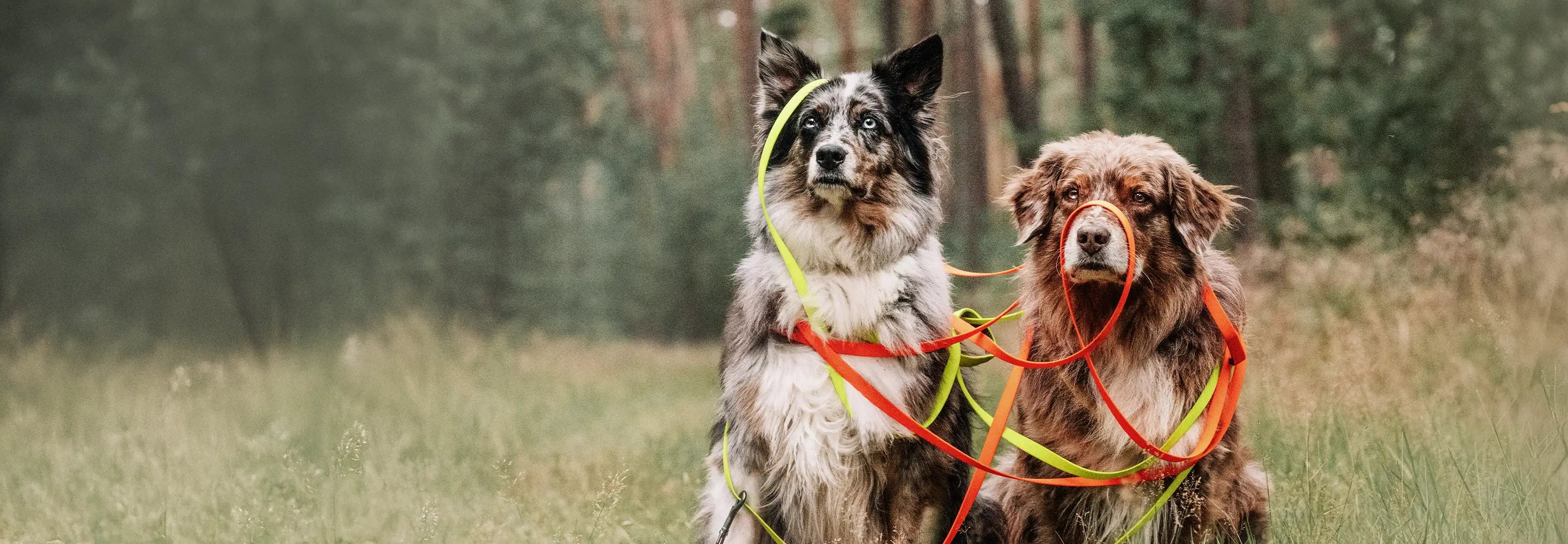
Tow line: Indispensable in recall training and for insecure dogs. Gives your dog freedom without loss of control.
-
Feed bag: Always at hand when praise is due. Promotes quick rewards – crucial for learning success.
-
Dog whistle: A clear, neutral signal - particularly effective during recall exercises and in noisy environments.
Important: Each of these devices only develops its full effect when it is embedded in a training strategy with structure, repetition and positive reinforcement. Use devices specifically – and not as a replacement for communication.
Dog Health and Safety: Fit and Safe Through Training
Your dog's health and safety are always our top priority when training. Before you start new exercises, make sure that your dog gets enough exercise and is physically exhausted - this not only promotes fitness, but also concentration during training. Make sure to choose training equipment that suits your dog and his needs. Whether it's a drag line, a food dummy or a dog whistle: the right tools will help you make training varied and safe.
Don't overwhelm your dog and pay attention to his signals. Breaks are just as important as the exercises themselves to keep your dog motivated and healthy. Rewards play a central role: They show your dog that he has done something right and increase the joy of training together. With these tips you will ensure that your dog not only learns effectively, but also safely and with fun - for a long, happy dog life at your side.
Online courses & expert offers: Train flexibly with a system
Digital offers are a real help for many dog owners - especially when there is no dog school nearby or everyday life leaves little room for fixed appointments. Many of these offers are aimed specifically at dog owners who want to train flexibly and regardless of location.
Good online courses are often offered by experienced dog trainers and provide not only instructions but also explanations of behavior, emotions and body language. There are also special training courses for dog trainers that enable exchange in an exclusive specialist network. The courses combine training videos, training plans and individual support. One example is online courses in dog sports, such as agility or obedience, which promote both the dog's physical and mental fitness. Many platforms also offer apps with reminder functions, training calendars and step-by-step instructions that make dog training more varied and suitable for everyday use.
Tip: Compare the course content and make sure that it suits your level of training and your dog's needs. In addition to the courses, you will often find helpful articles that provide further knowledge about dog training.
When choosing, pay attention to the following criteria:
-
Trainers with proven experience and training
-
Transparent content with video and text material
-
Community function for exchange with other dog owners
-
Integration of food reward, play and signal conditioning
When training stalls: Typical problems and their causes
Despite your best efforts, your dog may not understand certain exercises or exhibit stable behavior. Dogs often make their own decisions in problem situations based on their previous experiences and the rewards or consequences offered. The training should address this and address problem solving in several steps. Each exercise should be individually adapted to your dog’s needs. It's worth taking a second look here:
-
Stress or uncertainty: Pay attention to your dog's emotional state. Many dogs react sensitively to changes, noises or tensions.
-
Wrong environment: Too many distractions? A new environment with fewer stimuli can help.
-
Bad timing: Dogs don't learn well when they are tired, hungry or excited.
-
False reward: Is the food really motivating? Sometimes another treat or a short game helps.
Important: Training is not a linear process. Regressions are normal – what matters is how you deal with them. Approach the training in clear steps and check your dog's progress after each individual step. If necessary, get support from experienced trainers or attend a dog school together.
Children, customers, communication: training in real life
Clear rules are needed, especially in a family context. Dog owners have a special responsibility here because they have to ensure that all family members, especially children, learn how to properly interact with the dog. Children should not train with the dog unsupervised, but should be guided lovingly. Hand signals are particularly helpful because they give children a clear and understandable way to give commands to the dog.
An example from everyday life: The child shows the dog the command “sit” with his hand while a parent stands nearby to support him. This makes the training understandable and safe for both sides.
Tip: Start training with short, simple exercises and reward both the dog and the child for correct behavior. This motivates and ensures quick learning success in everyday family life.
A well-trained dog is also a blessing when it comes to contact with other people: sitting quietly when greeting, not jumping at customers or guests - all of this can be easily achieved with targeted training.
Conclusion: Dog training is a matter of the heart – and a craft at the same time
Well-thought-out dog training is not a rigid scheme, but a lively dialogue. Successful dog training is always built on solid foundations, such as teaching important commands and methods. Anyone who is willing to get involved with their dog will not only reap obedience, but also real trust and joy of life.
The key lies in the combination of knowledge, feeling, structure – and the willingness to learn. Whether you're just starting out or have a lot of experience, every dog is different and every training is a new chance to become a better team.
Discover now: The right training aids Pack King Shop
With the right equipment, you will not only train more effectively, but also have more fun. Discover our high-quality Food dummies, Tow lines, Feed bag and Dog whistles – developed for dog owners who know what’s important.

